We Use CookiesWe use cookies to enhance the security, performance, functionality and for analytical and promotional activities. By continuing to browse this site you are agreeing to our privacy policy

10 Best Beginners Welder 2026 in the United States
How do we rank products for you?

Our technology thoroughly searches through the online shopping world, reviewing hundreds of sites. We then process and analyze this information, updating in real-time to bring you the latest top-rated products. This way, you always get the best and most current options available.

headphones-stars

Our Top Picks

#1

Winner

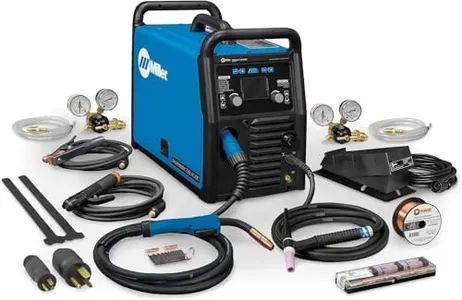
Miller 907757 Multimatic 220 AC/DC Multiprocess Welder - Versatile Multi-Process MIG, Flux-Cored & TIG Welder Machine - Portable Welding Machine with MIG Gun, TIG Torch & Multi-Voltage Plug 120V&240V

Rating
10.0
Chosen by1,246
Input Power

Most important from
44 reviews

Input Power
Having dual power options (110V and 220V) adds great versatility to the machine.

The Miller 907757 Multimatic 220 AC/DC Multiprocess Welder is a versatile choice for beginners looking to explore different welding methods, including MIG, TIG, and flux-cored welding. One of its standout features is the all-in-one capability, allowing users to tackle a range of projects without needing multiple machines. This makes it a great option for hobbyists or those just starting in welding, as it covers a variety of needs.

Ease of use is another major strength, thanks to the QuickTech feature that automatically adjusts settings according to the selected process. This reduces the learning curve and minimizes manual adjustments, making it more accessible for novices. The Auto-Set Elite and Pro-Set features further enhance user experience by simplifying setup and ensuring consistent, high-quality welds.

Portability is also a plus, with a weight of 56 lbs and the ability to connect to both 120V and 240V power sources. This allows users to work in various locations, whether in a home garage or at job sites, provided they have access to the necessary power supply. However, it may be slightly heavy for some users who prefer a lighter unit. Additionally, while it's designed for residential use, those looking for heavy industrial applications may find it lacking in power under continuous heavy loads.

Rating
10.0
Chosen by1,246
Input Power

Most important from
44 reviews

Input Power
Having dual power options (110V and 220V) adds great versatility to the machine.
#2

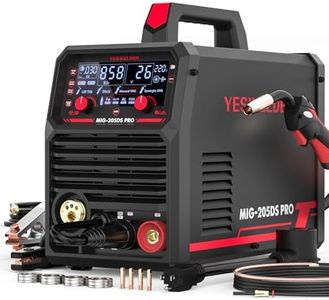
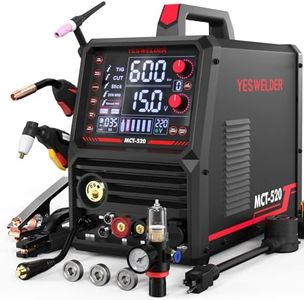
YESWELDER MIG-205DS PRO MIG Welder, 200Amp 110/220V Dual Voltage MIG Welding Machine, 5 in 1 Gas MIG/Flux Core MIG/Spool Gun MIG/Lift TIG/Stick Multiprocess Aluminum MIG Welder, Spool Gun Compatible

Rating
8.2
Type of Welder
Amperage Range
Duty Cycle

Most important from
2130 reviews

Type of Welder
This welder excels with its multi-process capability, supporting MIG, Flux Core, TIG, and Stick welding, making it highly versatile for a wide range of projects.
Amperage Range
Despite being a budget-friendly model, it delivers a strong 200 Amp output capable of burning through 3/16-inch steel plates even on 110V power.
Duty Cycle
The built-in fan offers impressive cooling, preventing overheating during typical homeowner use.
Input Power
Operating on both 110V and 220V power supplies offers great flexibility for home or workshop use.
Portability
Lightweight and compact design makes it easy to transport and store, perfect for DIY enthusiasts and small-scale projects.
Ease of Use
The digital display provides clear, real-time current readings that enhance control and learning during welding sessions.

The YESWELDER MIG-205DS PRO is a versatile 5-in-1 welder well-suited for beginners who want to explore different welding methods such as MIG, Flux Core, TIG, and Stick welding. It offers a strong 200 Amp output and supports both 110V and 220V input, making it flexible for various home or workshop power setups. The welder includes a synergetic MIG mode that automatically adjusts voltage when you change wire feed speed, which helps beginners achieve smooth welds without guesswork. For more experienced users, manual control lets you fine-tune settings to your liking.

The digital display is clear and shows real-time current, improving control and learning during use. Safety features like protection against overheating and voltage fluctuations add peace of mind, especially for those new to welding. While it handles a wide range of materials including steel and aluminum, using the additional modes involves some extra steps.

This welder provides excellent versatility, power, and beginner-friendly features, making it a strong choice for those starting out and looking to grow their welding skills across multiple techniques.

Rating
8.2
Type of Welder
Amperage Range
Duty Cycle

Most important from
2130 reviews

Type of Welder
This welder excels with its multi-process capability, supporting MIG, Flux Core, TIG, and Stick welding, making it highly versatile for a wide range of projects.
Amperage Range
Despite being a budget-friendly model, it delivers a strong 200 Amp output capable of burning through 3/16-inch steel plates even on 110V power.
Duty Cycle
The built-in fan offers impressive cooling, preventing overheating during typical homeowner use.
Input Power
Operating on both 110V and 220V power supplies offers great flexibility for home or workshop use.
Portability
Lightweight and compact design makes it easy to transport and store, perfect for DIY enthusiasts and small-scale projects.
Ease of Use
The digital display provides clear, real-time current readings that enhance control and learning during welding sessions.
#3

Lincoln Electric K4876-1 POWER MIG 215 MPi Multi-Process Welder

Rating
8.2
Type of Welder

Most important from
28 reviews

Type of Welder
Great welder with essential features, perfect for transitioning into DC TIG welding.

The Lincoln Electric K4876-1 POWER MIG 215 MPi Multi-Process Welder is a versatile tool designed to cater to various welding needs including MIG, Flux-Cored, Stick, and DC TIG welding. This multi-process capability makes it a valuable choice for beginners who want to explore different types of welding without purchasing multiple machines. The dual input voltage (120V and 230V) provides flexibility in power sources, allowing it to be used in various settings, from home garages to professional workshops. This flexibility is especially beneficial for beginners who may not have access to higher voltage outlets initially.

The ergonomic case design with multiple lift points enhances portability, making it easier to move around a workspace, which is a practical feature for users who might need to transport their welder frequently. Additionally, the built-in TIG solenoid and foot pedal adapter simplify setup, making it more user-friendly for those new to welding. The robust and reliable wire drive system ensures consistent feeding, which is crucial for achieving quality welds, especially for novices still mastering their technique.

Beginners who value versatility, ease of use, and portability would likely benefit most from this welder, though they should consider their specific needs and how often they plan to use the machine.

Rating
8.2
Type of Welder

Most important from
28 reviews

Type of Welder
Great welder with essential features, perfect for transitioning into DC TIG welding.

Buying Guide for the Best Beginners Welder

Choosing the right welder as a beginner can be a bit overwhelming, but with the right guidance, you can find a model that suits your needs and helps you learn the craft effectively. The key is to understand the different specifications and how they impact your welding experience. By focusing on your specific needs and the type of projects you plan to undertake, you can make an informed decision. Here are some key specifications to consider when selecting a welder for beginners.
Type of WelderThere are several types of welders, including MIG, TIG, Stick, and Flux-Cored. For beginners, MIG welders are often recommended because they are easier to learn and use. MIG welders use a wire feeding gun that makes the process more straightforward and allows for cleaner welds. Stick welders are more versatile and can be used outdoors, but they require more skill. TIG welders offer precision and control but are more complex and better suited for experienced welders. Flux-Cored welders are similar to MIG but can be used without gas, making them suitable for outdoor use. Consider the type of projects you will be working on and choose a welder that matches your needs and skill level.
Amperage RangeAmperage range refers to the amount of electrical current the welder can produce. This is important because different materials and thicknesses require different amperage levels. For beginners, a welder with an amperage range of 20-140 amps is usually sufficient. Lower amperage is suitable for thinner materials like sheet metal, while higher amperage is needed for thicker materials. If you plan to work on a variety of projects, look for a welder with a wide amperage range to give you more flexibility.
Duty CycleThe duty cycle is the amount of time a welder can operate continuously before needing to cool down. It is usually expressed as a percentage of a 10-minute period. For example, a 20% duty cycle at 90 amps means the welder can run for 2 minutes and then needs to cool down for 8 minutes. A higher duty cycle is better for longer welding sessions. Beginners should look for a welder with a duty cycle that matches the length of time they plan to weld. If you are just starting and will be welding in short bursts, a lower duty cycle may be sufficient.
Input PowerInput power refers to the electrical power required to run the welder. Welders can be powered by either 110/120V or 220/240V outlets. For beginners, a welder that runs on 110/120V is often more convenient because it can be plugged into a standard household outlet. However, if you plan to work on more demanding projects or thicker materials, a 220/240V welder may be necessary. Consider the power availability in your workspace and choose a welder that matches your power source.
PortabilityPortability is an important factor if you need to move your welder around frequently. Lighter and more compact welders are easier to transport and store. For beginners, a portable welder can be beneficial if you plan to work in different locations or have limited space in your workshop. Look for a welder with a handle or wheels for easy mobility. However, keep in mind that more portable welders may have lower power output, so balance portability with the power requirements of your projects.
Ease of UseEase of use is crucial for beginners who are just learning to weld. Look for a welder with user-friendly features such as an intuitive control panel, clear instructions, and automatic settings that adjust the welding parameters for you. Some welders come with features like auto-feed for the wire or self-adjusting arc, which can make the learning process smoother. Consider how comfortable you are with operating machinery and choose a welder that offers the right balance of simplicity and functionality.

FAQ